The Challenge of ‘Arcología’: Juan Miguel Aguilera’s New Novel
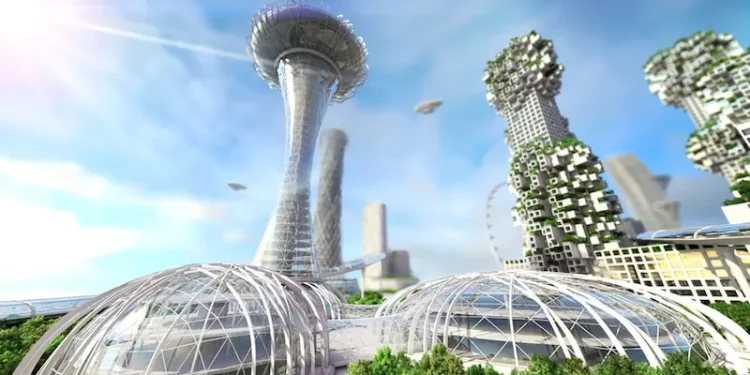
In the near future, the monumental arcology Xingfú Weilái rises along the coast of Brittany, revealing a world in which technology and humanity coexist in a delicate balance between utopia and dystopia.
Imagine a skyscraper a kilometer tall, where one million people live in comfort, inhabiting an environment designed for their well-being — yet under constant surveillance by cameras. This scenario might read as science-fiction fantasy, but it is the central premise of Arcología, the new novel by Juan Miguel Aguilera. Set between 2050 and 2100, the novel paints a portrait of a fully technologized future and interrogates what it means to inhabit a world in which privacy has been surrendered in the name of security. Aguilera blends genres with considerable skill, weaving crime fiction, speculative narrative, love, and revenge into a story saturated with reflection on human nature and the expanding reach of emerging technologies.
The novel’s title, Arcología, evokes the intersection of architecture and ecology — a concept that has gained considerable currency in recent years. The decision to situate this extraordinary structure on the Pink Granite Coast of Brittany is deliberate. Aguilera, a regular presence at literary festivals in the region, cites the importance of confronting the effects of global warming head-on. Arcologies such as Xingfú Weilái are no longer pure fantasy; real-world projects are already underway, from The Line in Saudi Arabia to Tokyo’s Shimizu Pyramid, suggesting that these architectural visions may be closer to realization than we care to admit.
The novel also poses provocative questions: will China emerge as the next hegemonic power, or is Europe destined for decline? “Science fiction does not predict the future — it merely extrapolates from what we already see,” Aguilera explains. This approach, grounded in science and sociology, gives his vision of the future an unsettling credibility. As Personal Agents — devices that connect individuals to a global AI — loom on the horizon, the question of privacy and intimacy becomes one of the most urgent of our time.
In this way, Arcología becomes a microcosm of our own society — one in which dazzling innovation proves powerless to extinguish the most fundamental human passions: love, hatred, and, inevitably, crime. With a style that provokes as much as it entertains, Aguilera transforms a futuristic setting into a mirror of our present anxieties, echoing the novel’s most resonant observation: “Perhaps utopias are only utopias for the visitors — never for the residents.” It is essential reading for anyone willing to confront what it truly means to live in a world advancing toward the unknown.
Juan Miguel Aguilera (born in Valencia in 1960) is a science-fiction writer who trained as an industrial designer and stands as one of the most significant figures in Spanish science fiction.
He has received the Ignotus, Alberto Magno, Imaginales (France), Bob Morane (Belgium), and Juli Verne awards.


 '
'