The Future of Space Exploration Has No Rockets
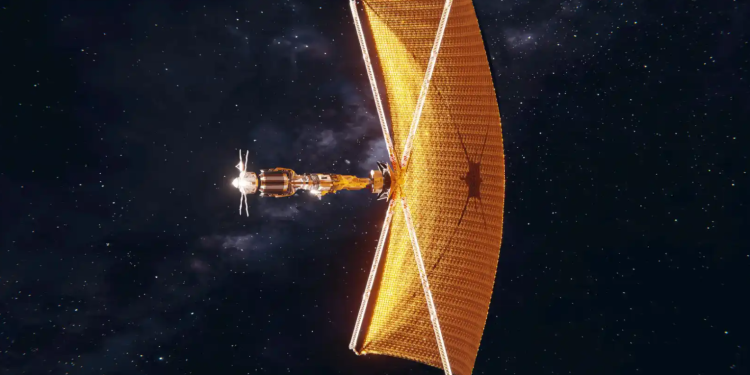
Space exploration faces a fundamental challenge: the vast distances involved and the severe limitations of current propulsion systems. While technologies such as nuclear fusion remain years from viability, solar sails are emerging as a genuinely innovative solution — one rooted not in science fiction, but in the elegant application of basic physical principles.
Unlike conventional engines, solar sails harness photons from sunlight to propel spacecraft. Each photon impact generates a minute force that, in the frictionless vacuum of space, accumulates into a sustained and constant acceleration. With no fuel required, solar sails dramatically reduce a vessel’s mass and open new possibilities for long-range missions.
A pivotal advance was recently published in Nature Communications: researchers at Brown University and the Delft University of Technology have developed an ultra-thin, ultra-reflective sail. At just 200 nanometers thick and equipped with nanoscale perforations that optimize its efficiency, this silicon nitride membrane represents a genuine milestone in space technology.
Beyond its extraordinary lightness, the material demonstrates strong resistance to deformation and high temperatures, and can be manufactured quickly and at low cost. According to the study, this sail achieves the highest length-to-thickness ratio ever recorded — surpassing all previous designs and positioning itself as a credible candidate for future missions.
This advance redraws the boundaries of space exploration. Solar sails could enable far more efficient travel within our own solar system and, ultimately, toward distant stars. What once seemed a remote dream is now taking shape as a tangible reality — one that may permanently alter our understanding of the cosmos.


 '
'