Trump Grants Temporary Automotive Tariff Exemption to Mexico and Canada: A Reprieve for North American Trade
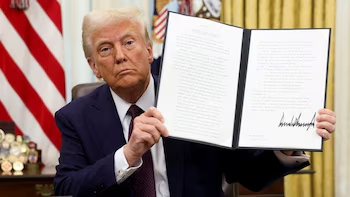
President Donald Trump has granted a one-month automotive tariff exemption for Mexico and Canada, as confirmed by White House Press Secretary Karoline Leavitt. The measure is designed to ease pressure on North America’s major automakers ahead of reciprocal tariffs scheduled to take effect on April 2. In a statement, Trump confirmed that the exemption applies to vehicles entering the United States under the United States-Mexico-Canada Agreement (USMCA), allowing companies such as Stellantis, Ford, and General Motors to sidestep these levies — at least temporarily.
Despite the gesture, Ontario Premier Doug Ford made Canada’s displeasure unmistakably clear. At a press conference, Ford emphasized that both he and Prime Minister Justin Trudeau remain firmly committed to a zero-tariff position. The objection carries considerable weight: automobiles represent Canada’s second-largest export to the United States, and any prolonged tariff regime has provoked deep concern not only at the government level but throughout the automotive industry itself.
Trump’s decision appears to be the opening move in a broader recalibration of trade policy — one that could meaningfully destabilize the region’s economic footing. Leavitt indicated that the president expects companies to use this month to align with his domestic production and investment objectives, operating free of punishing import duties. Yet the uncertainty surrounding the automotive sector is palpable. A new Institute for Supply Management survey found respondents reporting acute concern over the impact of future tariffs on their operations, adding another layer of pressure to an already strained industry.
Financial markets responded with measured optimism to the exemption announcement: the Dow Jones rose 540 points, while automotive stocks surged — Ford gaining 5.3 percent, Stellantis 9.1 percent, and General Motors 7.7 percent. The rally signals a temporary restoration of confidence, though investors are well aware that imminent reciprocal tariffs — for which no exemptions are currently on the table — pose significant long-term challenges.
In the end, Trump’s automotive tariff exemption offers a brief pause rather than a resolution in an increasingly volatile trade landscape. With the White House leaving open the possibility of further exemptions, many companies find themselves in a state of suspended uncertainty — facing the persistent threat of elevated tariffs that could fundamentally alter the commercial dynamics of North America. Whether this reprieve proves sufficient to navigate the complexities ahead, or simply becomes another flashpoint between the United States, Mexico, and Canada, remains to be seen.


 '
'