Pope Francis’s Devotion to Caravaggio
Pope Francis loved painting, but if there was one artist capable of moving him to his very depths, it was Caravaggio. Among all the master’s works, The Calling of Saint Matthew held a singular place in his heart. The Milanese painter’s canvas — charged with chiaroscuro and raw drama — not only accompanied him spiritually throughout his pontificate, but will now, after his death, stand as a silent witness to the election of his successor.
The work, painted in 1599 for the Contarelli Chapel in the church of San Luigi dei Francesi in Rome, depicts an episode from the Gospel of Matthew. But Caravaggio, true to his instincts, transposes the scene to a tavern — an ordinary, worldly setting — where a group of tax collectors counts coins beneath a thin shaft of light. At one edge of the composition, Jesus and Saint Peter enter the scene. Jesus points toward Matthew, who raises a hand to his chest in surprise, as if to ask: “Do you mean me? Why me?”
:format(jpg)/f.elconfidencial.com%2Foriginal%2F451%2Fa99%2F8c0%2F451a998c07c5e6ab595656fd92613ac6.jpg)
This scene of doubt and calling resonated deeply with the Pope. As the writer Enuma Okoro recounted in the Financial Times, Francis saw in that blade of light breaking into the composition — Caravaggio’s unmistakable signature — a metaphor for divine grace, the kind that can touch anyone at any moment. “We are all saved,” he believed. Redemption is available to all.
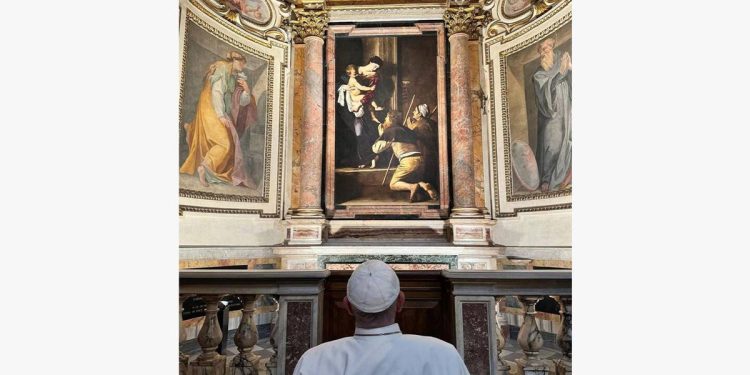
Francis was also seen praying before other works by the painter, among them the Madonna di Loreto — another controversial canvas, its model reputedly a woman named Lena, a prostitute, a choice entirely in keeping with the artist’s irreverent sensibility. It was no coincidence: Francis possessed a rare capacity to perceive the raw humanity and fractured beauty that Caravaggio rendered as no other painter before or since.
The Calling of Saint Matthew marked him so profoundly that, according to Rome Reports, an exact copy was made and now hangs in the Casa Santa Marta — the residence where the Pope lived throughout his pontificate, and where the cardinals summoned to the conclave are now lodged in those same corridors. Beneath that Caravaggesque gaze — dramatic, intense, laden with silence and everyday miracle — the future of the Church will be decided.

 '
'