Noland Arbaugh: A Landmark Moment in Neurotechnology
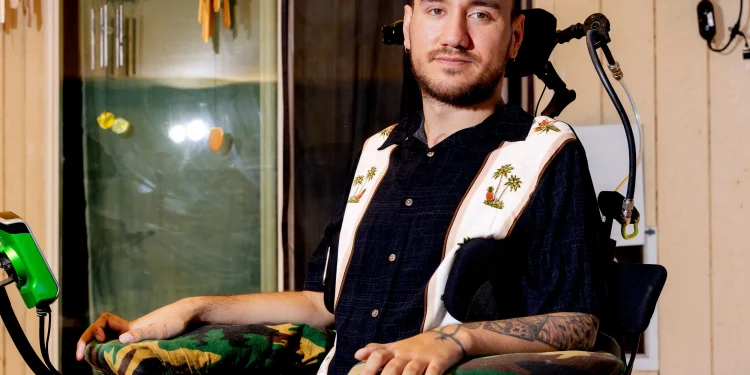
In a defining milestone for medical technology, Noland Arbaugh has become the first human being to receive a brain implant developed by Neuralink, the neurotechnology company founded by Elon Musk. “It blew my mind,” Arbaugh recounts. “Just that small taste made me realize this technology is going to change the world.” His remarkable story stands as a testament to what brain-computer interface technology can achieve in a human life.
Arbaugh’s world changed irrevocably in 2016, when a diving accident left him quadriplegic. After years of near-total dependence, he resolved to pursue a path toward reclaiming a measure of autonomy — however uncertain that path might be. In a recent interview with The Guardian, Arbaugh described the moment he controlled a computer with his mind alone as nothing short of revelatory. “My brain is the last part of myself over which I truly feel I have control,” he said before the procedure.
The accident occurred in New York when Arbaugh was just 22. During a day of swimming, he was struck accidentally, resulting in permanent paralysis. A young man who had lived for football and rock music found himself entirely dependent on his family for the most basic daily activities. Yet he refused to be diminished by it. “I felt no fear whatsoever,” he said — a statement that speaks to an uncommon resilience.
When Arbaugh learned of Neuralink‘s clinical trials in September 2023, he applied without hesitation. He understood the demands involved — exhaustive medical and psychological evaluations — but in January 2024, the confirmation arrived: he had been selected. It was, by any measure, a ray of genuine hope in an otherwise arduous daily struggle.
The Surgery and the Beginning of a New Era
The procedure took place on January 29, 2024, at the Barrow Neurological Institute and lasted fewer than two hours. “They removed a section of my skull and replaced it with the chip,” Arbaugh explained. With the N1 implant activated, he experienced the transcendent moment of interfacing with a computer through thought alone. “I saw a large yellow spike on the screen,” he recalls, as the Neuralink team celebrated the success of the procedure.
Arbaugh’s ambitions, however, extend well beyond what has already been achieved. He envisions connecting his implant to a Tesla vehicle or to Neuralink‘s Optimus robot — possibilities that represent a far greater degree of independence than he has known in years. He is not blind to the ethical questions this technology raises, but he remains deeply energized by its transformative potential for people in his position.
As he navigates the uncertainties ahead, Arbaugh is determined to turn his experience into advocacy. He intends to complete his university degree and become an active voice for the BCI (brain-computer interface) community. One question lingers: what happens when the Neuralink study concludes? He holds that uncertainty with characteristic equanimity.
Noland Arbaugh’s story is more than a breakthrough in neural technology — it is a window into a future where the interface between mind and machine promises to redefine our understanding of human autonomy. “I am content with my lot in life. I was before Neuralink, and I will be after. I will find a way.” His testimony is an invitation to reflect seriously on the road we are about to travel in the extraordinary world of neurotechnology.


 '
'