Money = Power: Welcome to the Secret Club
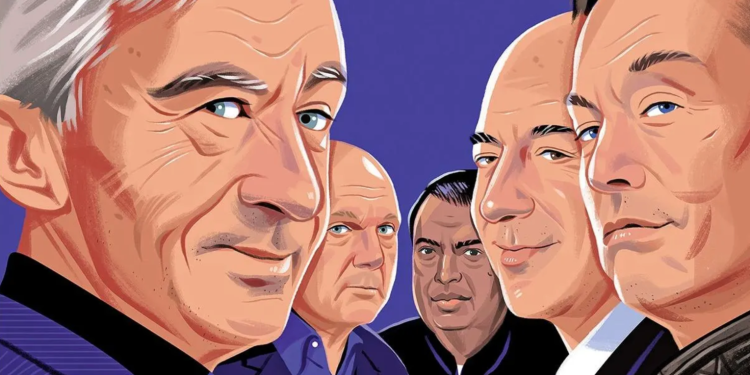
The $100 Billion Club: A Universe Where Money Commands Everything.
A record fourteen billionaires join the financial elite in 2023
In a world where fortunes appear to multiply without limit, the $100 Billion Club has become the defining symbol of the new financial elite. This year, a record fourteen individuals crossed that rarefied threshold — a remarkable increase from the six who qualified the previous year and just one in 2020. The majority of these new members hail from the technology industry, where ingenuity and innovation have built economic empires that defy conventional logic. This select group, whose combined net worth now stands at $2 trillion, accounts for 14% of all billionaire wealth globally — a figure that lays bare the deepening inequality even within the ranks of the ultra-rich.
The wealth growth of these centibillionaires has been nothing short of astronomical, surging 255% over the past decade — far outpacing the 120% recorded by their billionaire peers. Their net worth has not only left inflation and the broader equity markets behind (the S&P 500 returned 182% over the same period), but has become comparable to the most valuable franchises in professional sport, including the NFL, which itself saw franchise values rise 257%. Meanwhile, one prominent name stands at the threshold: L’Oréal heiress Françoise Bettencourt Meyers, whose fortune sits at approximately $99.5 billion.
The concentration of wealth raises urgent questions about the future of economic inequality
Historically, the ascent to this level of wealth has been rooted in specific, defining moments. When Forbes published its first wealth ranking in 1987, only two individuals possessed fortunes exceeding $10 billion. The first person to cross the $100 billion threshold was Bill Gates in 1999, at the apex of the dot-com bubble. Since then, we have witnessed exponential growth in this centibillionaire class — from Jeff Bezos to Elon Musk — whose disruptive vision and audacious bets have positioned them as the undisputed architects of the modern economy.
The current landscape reflects not merely an increase in wealth, but an alarming concentration of economic power in extraordinarily few hands. The fact that just 0.5% of the world’s 2,781 billionaires controls 14% of all billionaire wealth raises fundamental questions about the sustainability of a system in which money continues to purchase influence, privilege, and — in a very real sense — access to life itself. Are we, then, entering a new gilded age of those who own the world? This phenomenon of mega-wealth poses searching questions about wealth distribution, the social responsibilities of the ultra-rich, and the extent to which their decisions shape the daily lives of billions.
The billionaire elite continues to expand, and history makes clear that for many, membership in this exclusive club is not merely a symbol of success — it is an imperative for maintaining relevance in an ever-shifting global economic landscape. What is certain is that in this particular game, money does not simply open doors. It dictates the direction of entire industries and, more often than not, becomes the most decisive instrument in the pursuit of influence and power on a global scale.


 '
'