Microsoft Unveils a Chip That Could Transform Quantum Computing
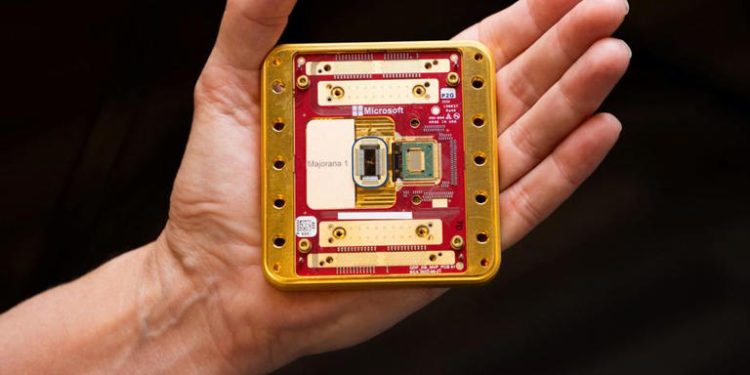
 Microsoft has taken a decisive step forward in quantum computing with the unveiling of its groundbreaking Majorana 1 chip. The advance is built on the use of topological qubits — a class of qubits that promises to carry quantum computing to an entirely new level of reliability and performance. Its development was made possible by the discovery of a novel material belonging to the family of topoconductors, which opens the door to quantum computers operating at the scale of one million qubits.
Microsoft’s Quantum Computing Announcement Ignites Global Anticipation
The announcement was accompanied by two landmark scientific papers — one published in Nature, the other on arXiv — detailing the properties and potential of the new chip. The research has drawn the attention of the Defense Advanced Research Projects Agency (DARPA), which has selected Microsoft to develop a prototype fault-tolerant quantum computer. This topological approach to quantum computing is widely regarded as essential to building the more reliable machines the sector demands.
The fundamental power of quantum computing lies in the ability of qubits to exist in multiple states simultaneously, a property known as quantum superposition. Unlike classical bits — which can only represent zero or one — qubits can occupy both states at once, enabling vastly greater processing capacity. It was this principle that underpinned the concept of quantum supremacy, which Google confirmed in 2019 by solving a complex mathematical problem in record time, far beyond the reach of classical computers.
Yet qubits have long been acutely sensitive to external interference, complicating the development of reliable quantum chips. This is precisely where the Majorana 1 changes the equation. By harnessing topological qubits, the chip becomes significantly less susceptible to environmental noise and the errors that can corrupt quantum operations. The result: far less error correction than conventional qubits require, and meaningfully more efficient control.
The Majorana 1: A Revolution in Quantum Qubit Reliability
Microsoft researcher Chetan Nayak has stated plainly that “we have reinvented the transistor.” Just as semiconductors redefined mobile technology, topoconductors and the Majorana 1 chip could pave the way for scalable quantum computers capable of operating at one million qubits. The researchers developed composite materials made of indium arsenide and aluminum, engineered and fabricated with atomic precision to minimize defects.
Testing has confirmed that the chip can detect minute differences in quantum capacitance, reinforcing its considerable potential. Microsoft has now set an ambitious roadmap: the creation of a fault-tolerant quantum computing prototype within the next few years — a milestone that would unlock practical applications including the design of self-healing materials, advances in sustainable agriculture, and the discovery of safer chemical compounds.
Microsoft’s Majorana 1 represents more than an incremental advance in quantum chip technology — it marks the opening of a new era in quantum computing. With the promise of one million qubits on the horizon, this development does not merely point toward more powerful quantum machines; it could fundamentally transform entire industries and raise the quality of human life in ways that are only beginning to come into focus. The quantum revolution is well underway, and the Majorana 1 may prove to be the catalyst the field has been waiting for.


 '
'