Mercedes-Benz Bets on Humanoid Robots: Is This the Future of Manufacturing?
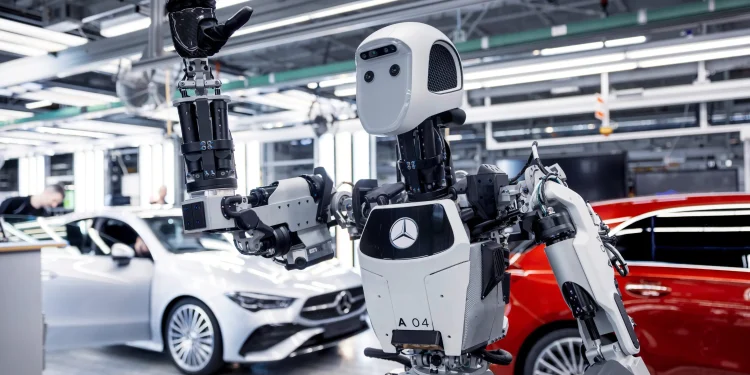
The German automaker is pressing its advantage at the frontier of industrial innovation, integrating humanoid robots into its production line to drive efficiency and confront a tightening labor market.
Mercedes-Benz has made a bold move toward the future of manufacturing. The company is piloting humanoid robots developed by American firm Apptronik — known as “Apollo” — to perform tasks including moving components along the production line and conducting quality control checks. A multimillion-euro investment in Apptronik signals a determined effort to overcome operational challenges in an increasingly demanding market.
Apptronik is competing directly with the likes of Tesla and Nvidia-backed Imagine AI in the race to develop artificial intelligence-driven robots that replicate the human form. These robots are already at work at Mercedes-Benz’s Digital Factory Campus in Berlin and at its facility in Kecskemet, Hungary. Training is conducted through teleoperation — a process in which a human operator controls the robot remotely as it learns the required tasks, with the ultimate goal of fully autonomous execution.
In the words of Head of Production Joerg Burzer, the company is focused on deploying robots in areas where labor shortages are most acute — though the ambition extends well beyond filling vacancies. “We want these robots performing repetitive and hazardous tasks,” Burzer stated. As the technology matures, cost will be the decisive factor in widespread adoption. “When costs come down to the tens of thousands of dollars,” Burzer noted, “it becomes genuinely compelling” for large-scale production.
Other automakers — among them Honda, Hyundai, and BMW — have explored humanoid robotics, particularly for hazardous or monotonous applications. Yet none has moved toward deployment at the scale Mercedes-Benz is now pursuing.
Mercedes-Benz is not merely adopting these advances — it is setting the pace, compelling rival manufacturers to reconsider their entire approach to automation. With each robot integrated into the production line, a new chapter in automotive manufacturing opens: one that promises meaningful advances not only in efficiency, but in workplace safety and the quality of human work itself.


 '
'