How Stellantis Is Leveraging the U.S. Tariff Exemption to Advance Its American Strategy
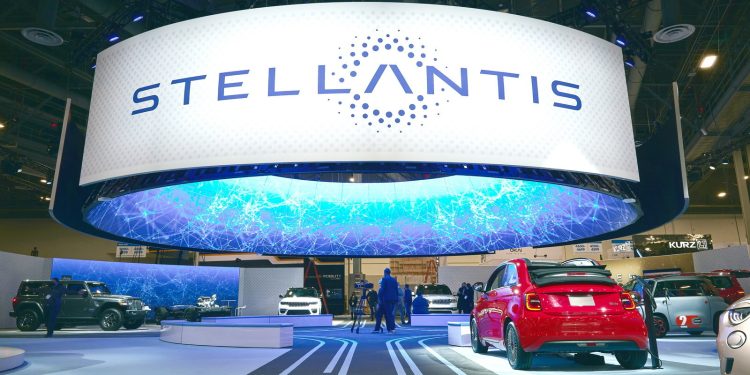

In a significant statement, Stellantis expressed its support Thursday for President Donald Trump‘s objective of expanding automobile manufacturing in the United States. The declaration came alongside the automaker’s acknowledgment of a one-month tariff exemption granted to its operations in Canada and Mexico. The White House measure, announced Wednesday, relieves automakers of a 25% tariff provided they remain in compliance with existing free trade rules.
In its statement, Stellantis was direct: “We thank President Trump for the decision.” The company expressed its commitment to working alongside the administration to build more American-made vehicles and foster the creation of durable jobs across the country. The announcement provided an immediate lift to the company’s Milan-listed shares, which rose 3.4% in early trading — a welcome recovery for a stock that had recently touched its lowest level since the group’s formation in 2021.
Born from the merger of Fiat Chrysler and PSA, Stellantis has established itself as a pivotal player in the automotive sector, with operations spanning the United States, Mexico, and Canada. The automaker is estimated to import approximately 40% of the vehicles it sells in the U.S. from those two countries — a figure that underscores its deep dependence on cross-border trade and its acute exposure to shifts in commercial policy. That dependence has come at a cost: the group has recorded a 64% decline in operating profit, driven by falling sales and mounting inventory levels in one of its most lucrative markets.
The situation carries additional complexity for Stellantis, which is currently led by John Elkann as the company searches for a new CEO following the December departure of Carlos Tavares amid mounting financial pressures. Elkann, scion of the influential Italian Agnelli family, met previously with Trump to explore potential synergies and reinforce Stellantis’s footprint in the American market — an encounter that may prove decisive in shaping the group’s trajectory through a rapidly shifting North American automotive landscape.
Stellantis is positioning itself not merely as a company adapting to market demands, but as a willing partner in the Trump administration’s vision of a stronger, more prosperous American automotive sector. As the group navigates significant headwinds — declining profits, inventory pressure, and a leadership transition — its stated commitment to domestic production and job creation will be the clearest measure of its resolve to compete in one of the world’s most contested automotive markets.



 '
'