From Protest to Postcard
From Protest to Postcard: How We See Picasso’s Guernica Today
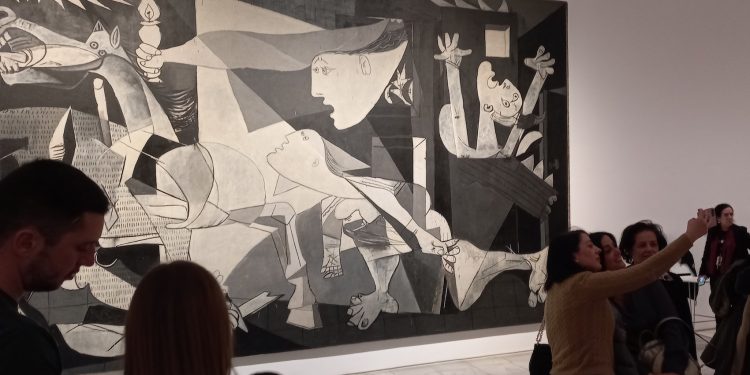
Every April 26, the echo of the bombing of Guernica returns in the form of footsteps, whispers, and camera clicks. At the Museo Reina Sofía in Madrid, visitors gather before the 7.75-meter canvas that Pablo Picasso painted to bear witness to horror. Now that photography is permitted, the work is no longer simply contemplated — it is framed, shared, posed against.

For decades, no one could photograph Guernica. Not a single image, not a stolen selfie. That changed in 2023, when the museum lifted its restriction and allowed visitors to document the painting that bears witness to the bombing of April 26, 1937 — when the German Condor Legion, allied with Franco’s regime, attacked the civilian population of Guernica on a market day. The toll: nearly two thousand dead and more than 80 percent of the town destroyed. A choreography of terror that would be rehearsed across Europe throughout the Second World War.
That is what Picasso painted: a bull, a wounded horse, a mother holding her dead child. The disintegration of humanity rendered in a single monochrome image. Yet in Room 205.10 of the Reina Sofía, the painting has also become backdrop — phones raised, palms outstretched to simulate holding the canvas, visitors competing for the best angle. The sketches and documents that surround the work receive scant attention.

Meanwhile, in Gernika-Lumo — the original town — the painting never arrived. For decades, its people have demanded that the work come home. In its place stands a ceramic mural of identical dimensions, at the foot of which visitors leave flowers, candles, and today, Palestinian flags. Guernica has been adopted as a symbol of other wars, other violences. In local shops, the mother and child appear superimposed on the Palestinian flag, and the Museum of Peace reminds its sixty thousand annual visitors that what happened here was no accident — it was an experiment in warfare.
The contrast with Madrid is stark. There, reproductions of the painting are colored at will and pressed into posters, keychains, and refrigerator magnets at street stalls. Outside the Reina Sofía and even the Museo del Prado, the bull, the horse, and the victims appear in new colors, reinterpreted endlessly. And yet something endures. Because as memorial, as selfie, as symbolic gesture or passing souvenir, Guernica never ceases to move. Its cry cuts through time, and in every gaze that meets it, the flame of memory reignites. Wherever it exists, it remains an act of resistance — a profound and undiminished longing for peace.

 '
'