Five-Minute Charge? This Is a Revolution.
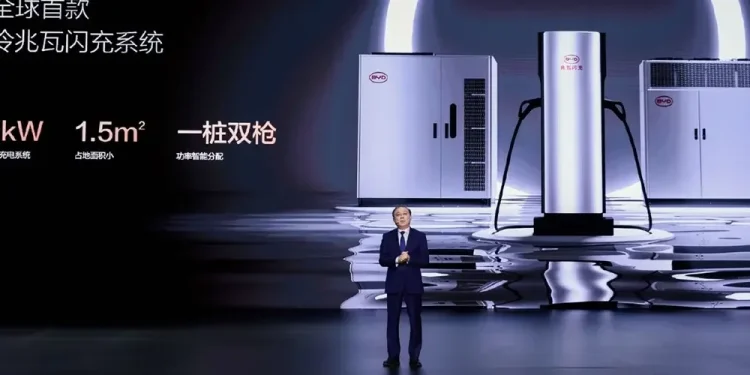
The Warren Buffett-backed Chinese automaker has unveiled an ultra-fast charging platform that promises to deliver up to 470 kilometers of range in just five minutes — a development that positions BYD at the absolute forefront of automotive innovation and places formidable pressure on rivals including Tesla and Mercedes-Benz.
Founder and billionaire Wang Chuanfu recently introduced the Super e-Platform, which enables electric vehicles to charge at a remarkable rate of 1,000 kW. In practical terms, a five-minute charge translates to approximately 470 kilometers of restored range.
Beyond its extraordinary charging speed, BYD has addressed several of the most persistent challenges associated with ultra-fast charging — among them battery safety, cycle life, and the cost of supporting infrastructure. Experts such as Shay Natarajan of Mobility Impact Partners note that BYD’s battery thermal management system is more sophisticated than that of most Western manufacturers. The result is a faster, more efficient charge that could effectively eliminate the range anxiety that continues to deter many prospective EV buyers. Advanced technologies including solid-state electrolytes and silicon anodes are quietly redrawing the boundaries of what electric vehicles can achieve.
Tesla has long been the dominant force in this space, yet its Supercharger network currently delivers no more than 320 kilometers in 15 minutes. Mercedes-Benz and BMW are pressing to close the gap, but both remain a considerable distance from what BYD is now promising. The tension is palpable across a market where legacy manufacturers must accelerate — or risk being left behind. Industry analysts project that competing automakers could reach comparable charging capabilities by 2030.
BYD’s ability to deliver genuinely innovative technology at relatively accessible price points represents a credible and growing threat to the global automotive establishment. The forthcoming launch of God’s Eye, a sophisticated driver-assistance system to be offered at no additional cost, only deepens the competitive pressure on rivals struggling to remain relevant.


 '
'