Cosmic Collision
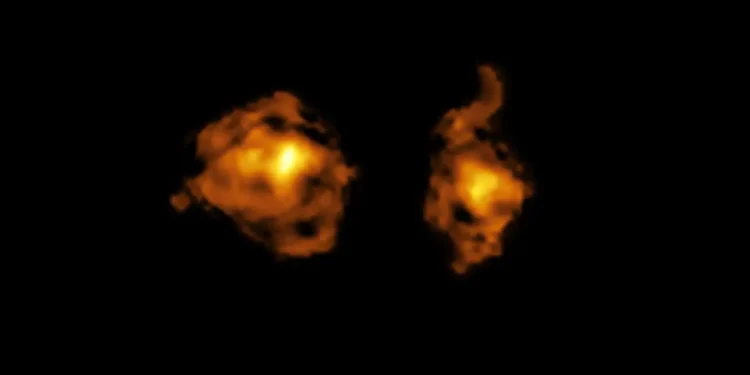
Deep in the cosmos, where light has traveled more than eleven billion years, a titanic confrontation is unfolding between two galaxies hurtling toward each other at speeds exceeding 500 kilometers per second. This violent encounter has been documented by astronomers who have observed one galaxy deploying a quasar — that luminous, supremely powerful nucleus fueled by a supermassive black hole — as a devastating weapon against its rival. Astrophysicist Pasquier Noterdaeme, of the Institut d’Astrophysique de Paris, has described the scene as “the cosmic joust.”
As these galaxies engage in a dance of collision and retreat, the quasar unleashes an intense torrent of radiation that not only strikes its adversary but actively suppresses the rival galaxy’s capacity to form new stars. The discovery, published in the journal Nature, marks the first time the tangible effect of quasar radiation on the structure of another galaxy has been directly observed. The result is stark: the targeted galaxy is rendered sterile, while the aggressor simultaneously feeds its own voracious black hole.
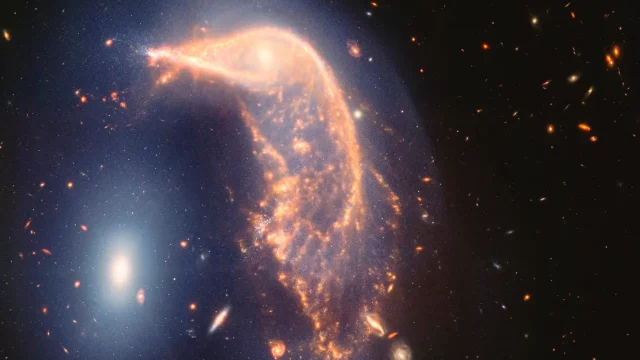 Photo: EFE/ NASA
The combined power of instruments such as the VLT telescope and the ALMA radio telescope — both situated in Chile’s Atacama Desert — has allowed scientists to visualize this galactic confrontation with unprecedented clarity. These observations reveal that such cosmic events, though isolated encounters, are capable of triggering cycles of destruction and renewal — sculpting the destiny of entire galaxies across the vast theater of the universe.


 '
'