Archaeologists Unearth the Tomb of Pharaoh Thutmose II After More Than a Century

 For the first time in more than a century, archaeologists have made a monumental discovery in Egypt: the long-sought tomb of Pharaoh Thutmose II, unearthed in the Theban necropolis near the storied city of Luxor. Announced by Egypt’s State Information Service, the find marks the last royal tomb of the Eighteenth Dynasty to be accounted for — a revelation that has sent a wave of excitement through the global archaeological and cultural communities.
A Historic Find: Thutmose II and His Tomb
Excavations began in 2022, led by a joint British-Egyptian team that initially believed the structure belonged to a royal consort rather than a pharaoh. Its proximity to the tombs of Thutmose III‘s wives and the celebrated Queen Hatshepsut reinforced that assumption. What began as a painstaking effort to identify a secondary burial would ultimately unfold as a far more consequential historical discovery.
The team confronted formidable challenges throughout. The tomb had suffered severe flood damage shortly after its original interment — the main corridor was choked with debris and sections of the ceiling had collapsed, complicating both access and identification. Excavation director Piers Litherland notes that this state of deterioration made reconstructing the site’s true history a significant undertaking.
The decisive clue lay in the decorative elements that survived intact: “Blue ceilings painted with yellow stars are found exclusively in the tombs of kings,” Litherland explains. That visual evidence proved the turning point — confirming beyond doubt that the structure was the burial place of a pharaoh.
Cultural and Archaeological Significance
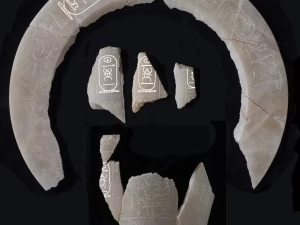
Among the finds were fragments of alabaster vessels bearing the names of both Thutmose II and Queen Hatshepsut, who, according to scholars, oversaw her husband’s burial. Yet the tomb’s most intriguing detail was its emptiness — not the result of looting, but almost certainly the deliberate relocation of the funerary assemblage following the flood.
Mohamed Ismail Khaled, Secretary-General of Egypt’s Supreme Council of Antiquities, has underscored the discovery’s singular importance, noting that it represents the first time funerary objects directly associated with Thutmose II have ever been found. The pharaoh, who reigned approximately from 1493 to 1479 B.C., is also notable for his marriage to Hatshepsut — one of the rare women to have ruled Egypt in her own right.
Today, the mummy of Thutmose II resides in the National Museum of Egyptian Civilization in Cairo, while the fate of the remaining funerary assemblage remains an enduring mystery. Litherland concludes that, for all the progress made, the full story of what happened in the aftermath of the flood has yet to be written.
This extraordinary discovery not only deepens our understanding of the Eighteenth Dynasty — it serves as a compelling reminder that the ancient sands of Egypt still hold secrets worthy of the world’s attention. The tomb of Thutmose II is at once a monument to human curiosity and an open door onto one of history’s most complex and captivating civilizations.


 '
'