A Colossal Sculpture That Breathes Like a Hive: Wolfgang Buttress’s The Hive
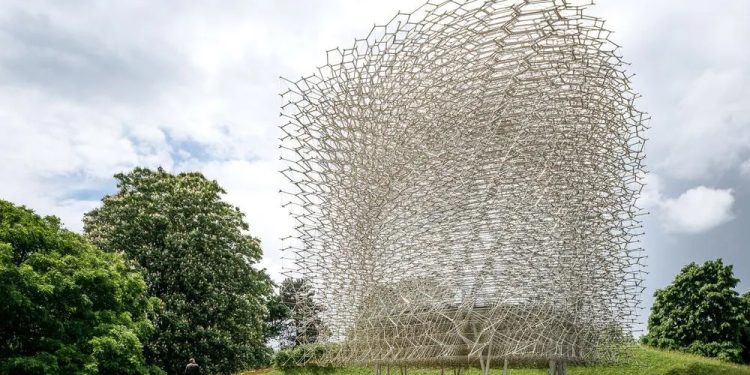
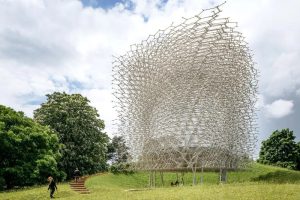
A hive without bees. A structure without blueprints. And yet one of the most unsettling sculptures of recent years. Standing more than 17 meters tall and weighing over 44 tonnes of aluminum, The Hive — by British artist Wolfgang Buttress — was not merely the centerpiece of the Sculpture Biennial. It was the most quietly radical manifesto art has ever made on behalf of the natural world.
What arrests you first is the scale. Thousands of aluminum components, cut with surgical precision, assemble into a metallic spiral that emulates the sacred geometry of a honeycomb. But it is not the visible that makes it singular — it is what cannot be seen: the vibration. The Hive responds in real time to the activity of a live colony, connected through sensors; its interior LED lights shift in intensity, and its internal hum becomes a symphony amplified by the architecture itself.
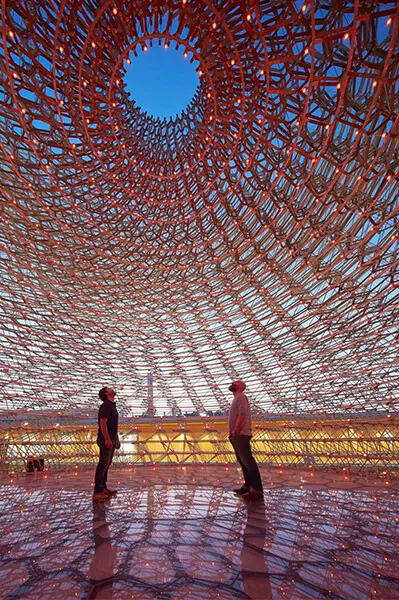
Visitors enter. They observe. They move through the hexagonal lattice as though exploring an entirely new ecosystem. The light filters through at a rhythm that belongs not to the artist, but to the bees. The result is an installation that changes with the hour, with the wind, with the seasons. This is not a sculpture — it is an immersive ecosystem.
The work had its origins in the United Kingdom Pavilion at Milan Expo 2015, but has since been reassembled, reinterpreted, and revitalized within the botanic gardens of Kew, in London. In every space it inhabits, it generates something beyond applause or photographs: it produces silence. The particular silence that descends only when the contemplative takes complete control.
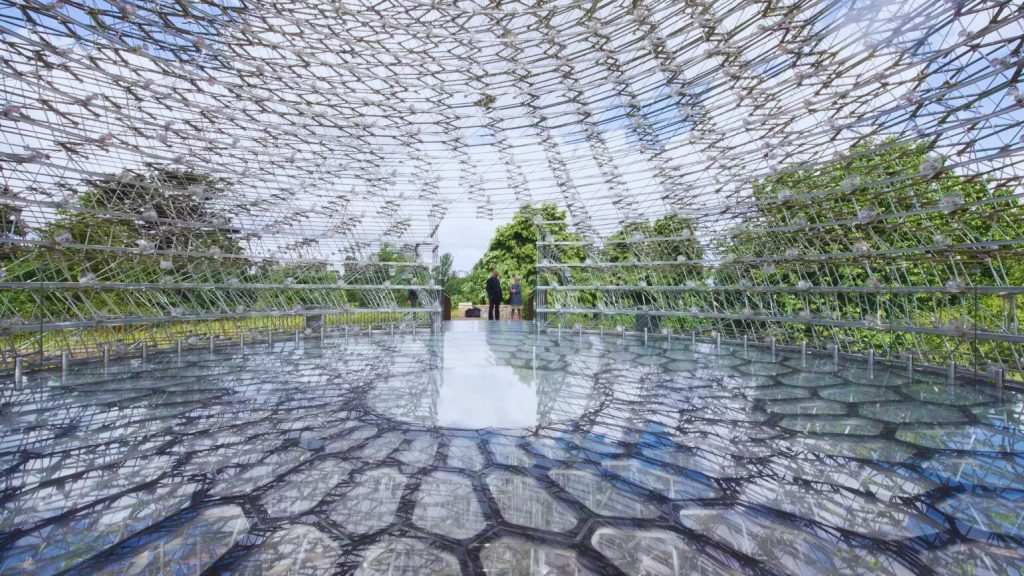
At a moment when contemporary art too often reaches for the shout, Buttress dares to whisper. He does so through a collaboration among design, science, and biology. His work does not seek to explain anything; it simply allows nature to take form, to provide rhythm, and to remind us — almost without saying so — that what is truly alive rarely requires ornament.
In an era when large-scale installations are synonymous with outsized budgets, political agendas, and gestures of urban power, The Hive stands apart with a different purpose entirely: to restore the severed connection to what we have forgotten to observe.
It may be no coincidence that this sculpture emulates a honeycomb. In the bee colony there is community, collaboration, and mathematical elegance — everything our architecture has labored to imitate without ever quite succeeding.
What The Hive places before us is an invitation to look, to listen, and to remember that even the coldest metal can draw us inward — into something colossal, alive, and wholly immersive.


 '
'