A Race That Changes Everything
Robots and Athletes Run Together for the First Time in Beijing
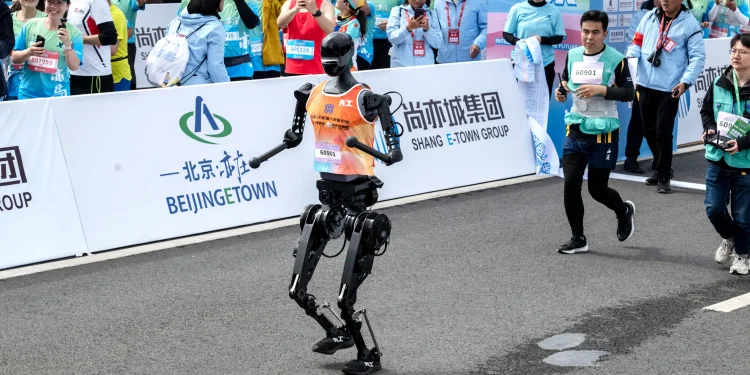
In a singular event, 21 humanoid robots and 12,000 human athletes competed side by side in the Beijing Half Marathon. With one robot clocking a remarkable 2 hours and 40 minutes, the race challenged every assumption about robotics and its evolution in competitive sport.
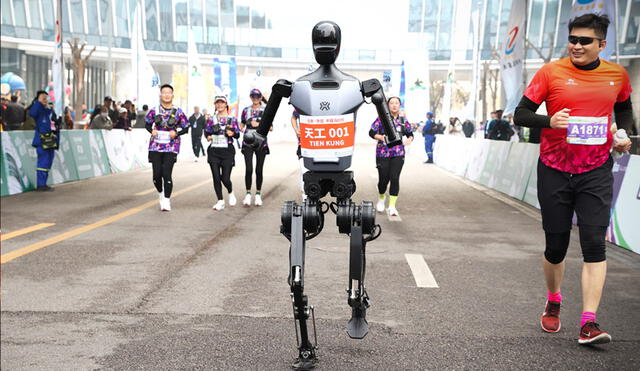
This past Saturday, Beijing bore witness to an unprecedented spectacle: a half marathon in which, for the first time, humanoid robots joined human athletes in the same competition — running on separate tracks, but under the same sky. While 12,000 runners demonstrated their endurance and form, a contingent of 21 robots — unable to match the human pace — staged a parallel spectacle that captured the imagination of everyone present. The fastest among them, Tiangong Ultra, developed by Chinese robotics firm UBTech, completed the course in 2 hours and 40 minutes — despite suffering a fall and requiring no fewer than three battery changes. A peculiar record, given that the minimum permitted finish time for human participants was 3 hours and 10 minutes.
Reactions to the event were decidedly mixed. Alan Fern, professor of robotics at Oregon State University, noted that while seeing robots walk is genuinely exciting, their development remains oriented toward specific tasks rather than speed. “The evolution of humanoid hardware has been remarkable, but there is still a considerable distance to travel,” he observed. Compared to just a few years ago — when robots fell with regularity — today’s machines display meaningfully improved robustness. Yet during the half marathon, the majority of humanoids encountered problems with overheating and falls, laying bare the technology’s current limitations.
More Than a Competition — A Singular Experience: The event was not merely an endurance test for the robots, but a genuine cultural moment. Although the humanoids posed no real competitive threat to the athletes, many human runners stopped to take selfies with Tiangong Ultra, contributing to an atmosphere of camaraderie and wonder. That impulse toward interaction underscores how these advances in robotics — however promising — must still demonstrate practical utility beyond the spectacular. “People will tire of watching robots dance or run; what we need is versatility and genuine usefulness in daily life,” Fern affirmed, turning his gaze toward the future of robotics in China.

In the end, the Beijing Half Marathon was not merely a race — it was a candid exhibition of the progress and the persistent limitations of contemporary robotics. Tiangong Ultra may have been the event’s undisputed protagonist, but the road ahead remains long. As humanoids continue to evolve, the twin demands of technological advancement and practical application will keep guiding researchers forward. The future lies not in the spectacle of a race, but in the capacity of these machines to become genuinely useful partners in the fabric of daily life.


 '
'