Jeff Koons and Louis Vuitton Make History — and Court Controversy
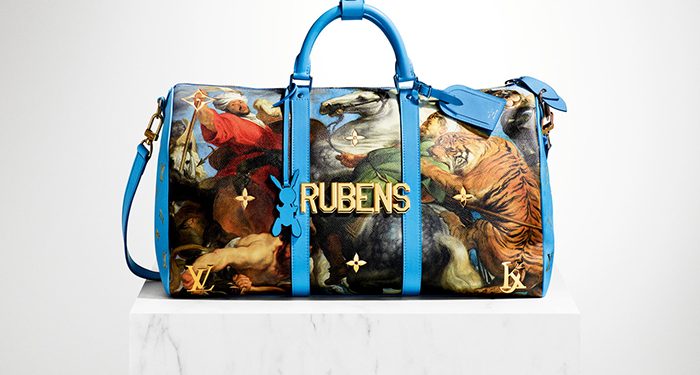
A bag that fuses art and fashion — while quietly questioning the true nature of cultural value. Rubens becomes an object of desire.
In a move that many have found controversial, celebrated artist Jeff Koons has designed a handbag collection for Louis Vuitton that incorporates imagery drawn from the masterworks of art history. Among the most arresting pieces is the bag bearing Rubens’s celebrated canvas The Hunt of the Tiger, Lion, and Leopard — an accessory that functions simultaneously as a fashion object and an invitation to reflect on how art is appropriated and, all too often, superficially celebrated within the world of consumption.
Koons’s series, known as Gazing Ball, includes reproductions of iconic works such as Da Vinci’s Mona Lisa and Titian’s Mars, Venus, and Cupid, each adorned with electric-blue spheres that collide with the richness of the originals. The bags display the artists’ names in gleaming metallic letters — rendered, unmistakably, as logos. The result is a jarring visual in which art is reduced to promotional material, suggesting a critique of the vulgarization of art concealed beneath the guise of accessibility.
Branding is omnipresent, with Louis Vuitton and Jeff Koons competing for the eye on every surface. This visual overload raises pointed questions about the frivolity of design and its true purpose. Through his work, Koons appears to toy with the idea that these bags are not merely status symbols, but artifacts of an era that consistently prizes self-regard — even as it endlessly appropriates what is genuinely valuable.
Louis Vuitton’s ambitions for the collection extend beyond the transactional. The House chose the Musée du Louvre as the official launch venue on April 11th, framing the collaboration as a means of bringing culture closer to the public. Yet at approximately €3,000 per bag, it becomes difficult to ignore the possibility that this particular act of cultural outreach may be more concerned with generating revenue than with democratizing access to art.
The charm suspended from the handle — a miniature reproduction of Koons’s iconic Rabbit — is the detail that crystallizes the entire controversy. Like a jewel adorning an otherwise ordinary object, it lays bare the deeper argument: that behind every thread of luxury, a profound debate persists about the meaning of art in the 21st century. In a world where the ephemeral is routinely celebrated, it is worth asking whether we are content to let art continue its transformation into merchandise — or whether we are finally prepared to take a more critical and considered position on this collision between culture and consumption.



 '
'