A Masterwork of Nearly One Million Pieces at the Palacio de Bellas Artes
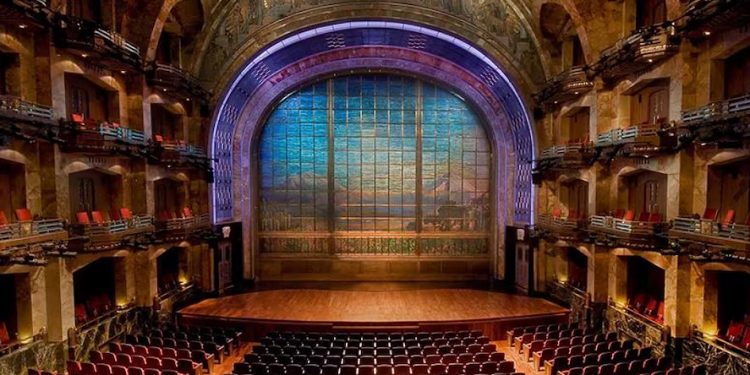
Nearly one million pieces of Favrile glass — the iridescent, handcrafted material created by Louis Comfort Tiffany in the late nineteenth century — compose this masterwork depicting the majestic Valley of Mexico, a testament to the fusion of international artistry and Mexican cultural identity.
The glass curtain of the Palacio de Bellas Artes is far more than a stage curtain; it is a testament to the ingenuity and artistry of Louis Comfort Tiffany, who designed it alongside his team at Tiffany Studios in New York. Commissioned in 1909 and completed in 1911.
A Work Where Art and Technique Converge
Favrile glass is distinguished by its iridescent tonalities — a full spectrum of color that shifts and shimmers in response to light. The curtain depicts an iconic landscape of the Valley of Mexico, where the mythic volcanoes Iztaccíhuatl and Popocatépetl preside over the scene.
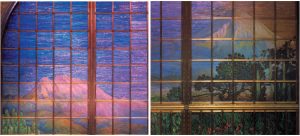
Over fifteen months, twenty specialized mosaic artisans devoted themselves to bringing each piece to life. The glass was produced at Tiffany’s factory in Corona, Long Island, while the substantial bronze frame was cast at the company’s metalworks. The completed curtain was exhibited at the Tiffany showrooms in New York before making its journey to the port of Veracruz in June 1911 aboard the steamship Monterrey.
Among the curtain’s most remarkable qualities is its engineering. Measuring approximately 14.5 meters wide and 12.5 meters tall, it weighs some 22 tonnes — yet remains fully operational, raised and lowered with ease by a sophisticated electric system that belies its extraordinary mass. Its design also incorporates fire resistance, setting it decisively apart from conventional fabric stage curtains and making it as safe as it is spectacular.
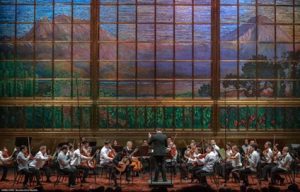
The glass curtain is not only a technical achievement — it carries an immense cultural weight. It stands as a tribute to the majestic Mexican landscape and a symbol of the profound connection between international artistic mastery and Mexico’s own cultural identity. To stand before it is to be reminded of the depth of that heritage and the enduring power of art to give it form. The Palacio de Bellas Artes rises, in this light, not merely as a venue for performance, but as a sanctuary of history and culture — one that radiates through every facet of its extraordinary glass curtain.


 '
'