Encarta: The Brilliant Hook Microsoft Released Before Its Time
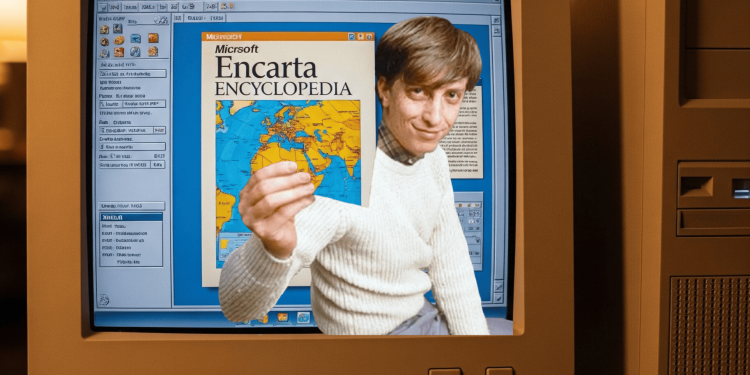
How does an educational product become a global sales weapon? And why did the giant that created it choose to abandon it precisely when it had the most room to evolve?
In 1993, when computers still smelled of the office and the CD-ROM seemed like laboratory equipment, Bill Gates dreamed of fitting all the world’s knowledge into a silver box. Not to make history — that would come later — but to accomplish something more urgent: persuading households to want a PC.
That ambition gave birth to Microsoft Encarta, a digital encyclopedia that was never merely an editorial project. It was, in truth, a commercial Trojan horse. And it worked.
For more than a decade, Encarta served as the golden hook that persuaded parents, teachers, and governments to invest in technology. It was not an educational application — it was the aspirational symbol of a new kind of knowledge. In an era without Wikipedia, without YouTube, without Google in the classroom, owning Encarta meant being current.
Behind that icon, however, lay resistance. When Microsoft sought to license content, the prestigious Encyclopaedia Britannica declined the offer. They did not believe in the digital format. Gates pivoted to Funk & Wagnalls and acquired rights from Collier’s and New Merit Scholar, lesser encyclopedias. The result? A product whose power resided not in its sources, but in its interface. Encarta seduced visually. It taught through clicks. It won by design, not by tradition.
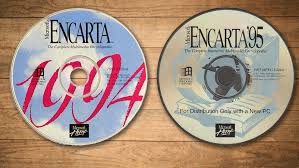
Its impact was immediate: more than 62,000 articles, videos, virtual tours, 3D animations. Each update arrived as a fresh promise of the future. For years, it shipped with PCs in schools and homes. Microsoft never disclosed precise figures, but NPD Group reports positioned Encarta as the best-selling digital encyclopedia of its era, generating hundreds of millions of dollars annually from licenses, discs, and premium editions.
And then the web arrived.
Wikipedia launched in 2001 as an open encyclopedia, editable by anyone. No design. No music. No interactive maps. But with a single powerful idea: free access, from any browser. Within five years, Wikipedia had surpassed one million articles. Encarta remained an exquisitely packaged jewel — but the jewelry business was no longer in fashion.
In 2009, Microsoft shuttered the project. Officially, “because the way people consumed information had changed.” Unofficially: because Encarta was no longer selling PCs. And Microsoft does not sell nostalgia.
Why do we still miss it?
Because it was not merely content. It was curation. It taught us to research with our hands. To navigate with a cursor. To complete assignments against a backdrop of music and satellite maps. Because before the age of infinite distraction, Encarta offered focus, context, and beauty.
And yet —
What is most remarkable is not that it closed. It is that no one picked up the baton. Where is the digital encyclopedia today that combines visual narrative, editorial depth, and verified knowledge? Why do the generations that grew up with Encarta now settle for TikTok fragments and AI summaries?
The lesson is unambiguous:
Encarta did not die of obsolescence. It died because its mission was complete: ensuring that everyone owned a computer. And like any well-designed hook — it is released once the catch is made.
What if you are ignoring your own “Encarta”?
- Do you have a product that does not monetize on its own, but opens the door to the rest of your business?
- Are you prepared to release it when it stops working — or before it does?
- Are you building something others will still miss years from now?
Because sometimes the most valuable product is not the one that sells the most, but the one that makes the invisible inevitable.


 '
'